Difficulty curves chart how challenge evolves, matching player skill growth to sustain flow—unlike raw spikes that frustrate without teaching. In 2026, with retention as gaming’s king metric (D1 medians at 22%), curves prevent churn by balancing boredom and rage quits.
Defining Difficulty Curves vs. Raw Challenge
A difficulty curve plots challenge (Y-axis) against player skill/resources (X-axis). Ideal: A rising line hugging the diagonal for flow—slight lead keeps tension without overwhelm.
Raw challenge? Sudden walls or uniform hardness. Spikes (e.g., untelegraphed bosses) cause 70% drop-offs; flat lines bore veterans.
Curves use peaks (bosses) and valleys (mastery phases) for rhythm.
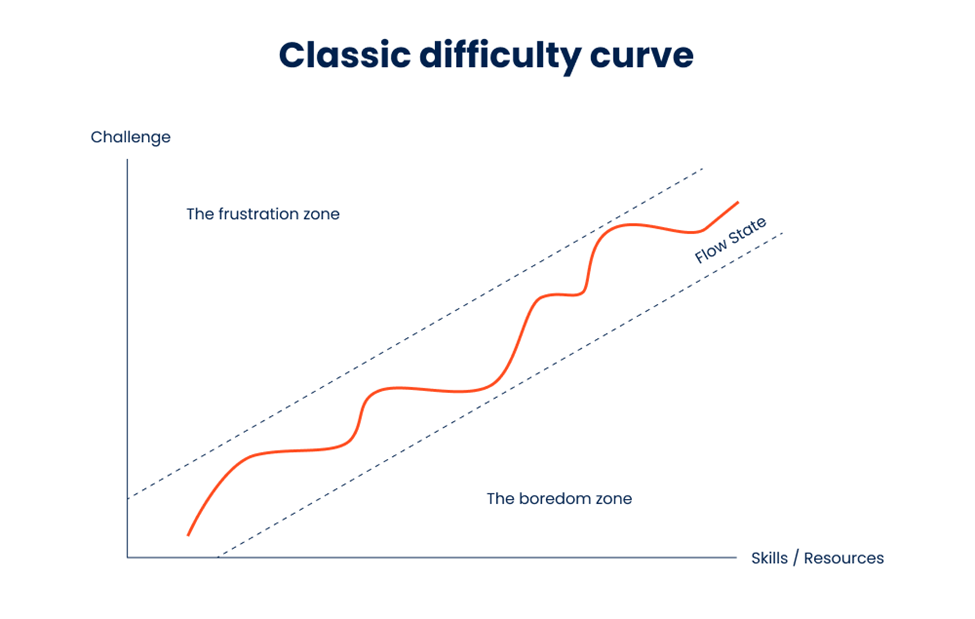
Difficulty curves: how to get the right balance
The Flow State: Psychology of Engagement
Mihaly Csikszentmihalyi’s flow: Optimal when challenge matches skill—immersion peaks, time flies. Curves induce this; raw difficulty disrupts.
Boredom (easy) kills motivation; frustration (hard) spikes quits. Analytics show retention dips at curve breaks—e.g., post-level frustration zones.
Skill plateaus let mastery sink in, priming peaks.
Retention and Completion: Data Proves Curves Win
Balanced curves boost metrics: Retention/completion flag issues—high completion? Too easy; dips? Spikes.
Mobile: D1 22% median; top 40% via curves. Steam: Souls games (Elden Ring ~30-40% completion) outsell easy titles despite low finishes—engagement trumps completion.
Doom Eternal: 41% completion on high difficulty signals strong curve.
Metrics Impact Table
| Curve Quality | D1 Retention Uplift | Completion Rate | Example Genre |
|---|---|---|---|
| Poor (Spikes) | -20-50% | <10% | Some Soulslikes |
| Balanced | Baseline +15-30% | 20-40% | Platformers |
| Adaptive | +25-50% | 30-50% | Roguelites |
Masterclass Examples: Celeste’s Precision Ramp
Celeste exemplifies: Chapters introduce dash/wall climb gradually; B/C-sides escalate combos. Assist Mode flattens for accessibility without diluting mastery.
Curve: Gentle start, steep mid-game peaks, plateaus for practice. Result: 45%+ long-term play, emotional payoff via perseverance theme.
Hades: Roguelike Meta-Progression Magic
Hades softens permadeath via boons/upgrades across runs—early frustration yields empowerment. God Mode (2% DR/death) eases curve dynamically.
Curve: Per-run spikes teach; meta smooths overall. Retention soars—millions hooked despite “hard” label.
Black Myth: Wukong—Mixed but Teachable
2024’s hit ramps bosses teaching patterns; uneven spikes (late chapters) drew criticism, yet 80%+ approval for “fair” curve vs Souls.
Power fantasy via transformations eases ramps, boosting completion.
Pitfalls: When Curves Fail
Raw spikes: Sekiro’s Isshin (unprep’d mechanics). Flat: Early games bore pros.
Satterthwaite Peak: Steep tutorials frustrate noobs—minimize via intuitive controls.
Principles for Crafting Curves
- Introduce Gradually: Tutorials as challenges—new mechanics at valleys.
- Peaks and Valleys: Boss highs, practice lows.
- Player Agency: Upgrades, skips.
- Test Iteratively: Playtests map skill vs challenge.
Curve Shapes Table
| Shape | Description | Best For | Risk |
|---|---|---|---|
| Linear | Steady ramp | Tutorials | Predictable boredom |
| S-Curve | Slow start, explosive end | Campaigns | Late frustration |
| Sawtooth | Peaks/valleys | Boss-rush | Rhythm dependency |
Adaptive Difficulty: 2026’s Frontier
Dynamic AI scales foes; roguelites use meta-progression. Celeste Assist, Hades God Mode personalize.
AI analytics predict churn, auto-adjust—+25% retention projected.
Designer Tools: Analytics and Playtesting
GameAnalytics tracks funnels; heatmaps spot spikes. GDC: Profile early.
A/B test levels; cohort retention validates.